Before It Was Mine - A Night at The Living Archive Fashion Show

Updated: Oct 2
Not every fashion grl can be in NY during fashion week, someone’s (me) gotta hold it down in San Francisco. An inside look on Before It Was Mine by The Living Archive, plus an exclusive interview with the founder, Kara Fabella.
Left to Right: CL Design, Runway, Textiz Weave + Emordes Studio, Lily Forbes.
Before It Was Mine by The Living Archive, photographed by Camy Totah.
Every September, I yearn to be in NYC amidst all the New York Fashion Week action. My dream is to attend a show of any designer whose archived 90s runways I’ve grown up watching on Youtube, from the likes of Alexander McQueen, Dior, Blumarine, Dolce & Gabbana, and Versace. As expected, NYFW made some interesting headlines like a PETA protest turning into a physical altercation at COS, but I think San Francisco deserves a special spotlight this season.
Because although SF is not the first city that comes to mind when you think of fashion, the local scene proudly popped out in a way that is so uniquely its own. Contrary to popular belief, San Francisco is not just tech-branded Patagonia vests and the Uniqlo HEATTECH. As a Bay Area native, it irritates me when people assume that SF style is completely synonymous with corporate athleisure wear. Although the city is widely recognized as the epicenter of technology and AI, the style here has always been rich with culture, intention, and sustainability. This is exactly what was shown at Before It Was Mine, the second iteration of by The Living Archives’ fashion and community series. The immersive event explored the intersection between fashion, art, heritage, and conscious craftsmanship; specifically examining the history of a fabric, technique, or a silhouette.
Left to Right: Designs by Textiz Woven and Emordes Studio, Emotion Potion. Photographed by Camy Totah.
Representing Club Rambutan, I was given the opportunity to attend this special two-night fashion show and immersive event exhibition as a VIP guest alongside our resident photo + videographer, Bridget Hawkley <3. It was an immersive community-building experience that featured hands-on repair activations, local food vendors, panel discussions hosted by KQED, a sculptural installation by Lizzie Oh, and of course, the 18 core independent fashion designers that were the heart of the event:
Nianna, a Filipino-American rooted fashion brand founded by Nicole-Jocelyn Sanchez.
The Alamaari Room, a curated trunk show series showcasing slow fashion designers, founded by Subikksha Balaje.
Textiz Weave, utilizes pre-colonial Ilocano weaving techniques founded by Izabelle Fernandez & in collaboration with Emordes Studios, founded by JH Sedrome.
Lily Forbes, an independent Los Angeles fashion designer explores romance and timeless silhouettes, with socially and environmentally conscious production.
First Principles, a fashion brand focused on 5 core principles: care for people, ecosystems, stories, bodies, and plants, designed by Christopher Burke.
Black Picasso, designed by Hakim Waters, fuses graphic design, fashion, illustration, and storytelling into culturally resonant garments.
Bodies As Clothing, founded by Allen Litton, utilizes Southeast Asian and Irish textiles to create animism rooted pieces and works with Balinese artisans.
Herderin, a regenerative, size inclusive apparel brand using plant dye and natural fibers, and based on “sartorial labor”, founded by sociologist Alexandria Vasquez.
Emotion Potion, a sustainable fashion brand upcycling vintage and wholesale garments through overdying, visible mending, and patchwork, founded and designed by Viviana Matsuda.
Auerstyle, designed by Amy Auerbach, is a San Francisco-based artist and educator who utilizes discarded textiles, film, and materials into wearable garments.
3D.Design.Decrease.Distribute, a slow fashion brand aiming to reduce textile waste through upcycling and repair, designed and founded by Fruimesha Brown.
Delicate Cycle, founded by Tori Ewald, is an upcycling brand that turns gently worn t-shirts into unique patchwork pieces.
Studio Renshaw, founded by Philippa Renshaw, is an independent textile art and fashion studio, combining textile art installations and hand-guided machine embroidery.
CL Design, founded by Calixta Lehman, whose work explores introspection and collective experience, centering sustainability and underrepresented communities.
Gaykiss, founded by jewelry designer, Nico Corona, explores the “queerness of metal” and draws inspiration from everyday items from Chicanx homes into sculptures embodying resilience and collective autonomy.
Upcycled Central, founded by maker Juliane Roberts-Hansen, uses discarded materials such as broken glass and discarded ceramics into handcrafted, wearable art.
KJ Studio by Kelsie, reworks discarded materials into modern, sculptural pieces and reimagines waste with design innovation.
Anna Monet Studio, founded by designer, artist and metalsmith, Anna Danilova, designs jewelry with intentionality and respect for natural materials.
Left to Right: Designs by Studio Renshaw, Bodies As Clothing, Ninanna, Delicate Cycle.
Photographed by Camy Totah.
Left to Right: Designs by Upcycled Central, Black Picasso.
Photographed by Camy Totah.
Set at The Rivian [car dealership] in Hayes Valley, you’d think it’d be unassuming. But you’re wrong. The space itself is beautiful, with high ceilings and a big space for all the activities. Wherever you looked, there were gorgeous floral arrangements cascading into the runway.
Left to Right: Selfie of Tiffany Hua (me) and Bridget Hawkley (CR Photographer), Photographed by Camy Totah.
Upon entry, we were immediately greeted by Lizzie Oh’s sculpture. The installation was built from fabric remnants and cyanotype, “transforming discarded textiles into a living record or memory and lived experience. An archive that’s physical, layered, and always changing.” The sculpture was also displayed as part of the runway, something that Kara Fabella, the founder of The Living Archives was adamant about.
Art Installation by Lizzie Oh. Photographer by Camy Totah.
What stood out the most was the intentionality behind every detail, especially through the use of cyanotype printing. This technique of creating deep, Prussian blue monochromatic prints with UV rays and chemicals was used in both the sculptural installation and branding for Before It Was Mine. To design the promotional flyers, Emilia Tongson led the graphic art direction of utilizing a custom cyanotype background and interactive details (such as library checkout cards), to embody the literal idea of garments passing through generations. Alice Kuang later executed this design. More on this in my conversation with Kara below!

Promotional flier for Before It Was Mine, artistic direction by Emilia Tongson and designed by Amy Kuang.
Natalie from HerDJClub was spinning records and setting the ambiance. There were local food vendors like The Buoy, a Korean inspired cafe, and Estrellita’s Snacks, selling family-made pupusas. There was also a showroom exhibiting various clothes and jewelry made by the 18 designers where people could peruse and shop before the night commenced. It was so cool to be able to physically touch and see the pieces yourself, and some of the designers were there! A good friend of mine, Juliane Robert-Hansen, jewelry designer and owner of Upcycled Central had pieces used in the show and was included in the showroom. She specializes in upcycling different materials and making them into wearable jewelry and accessories. There was a beautiful oversized translucent O-belt displayed and she had told me she had made it from broken glass she found on the streets of SF (pictured below on the far right).
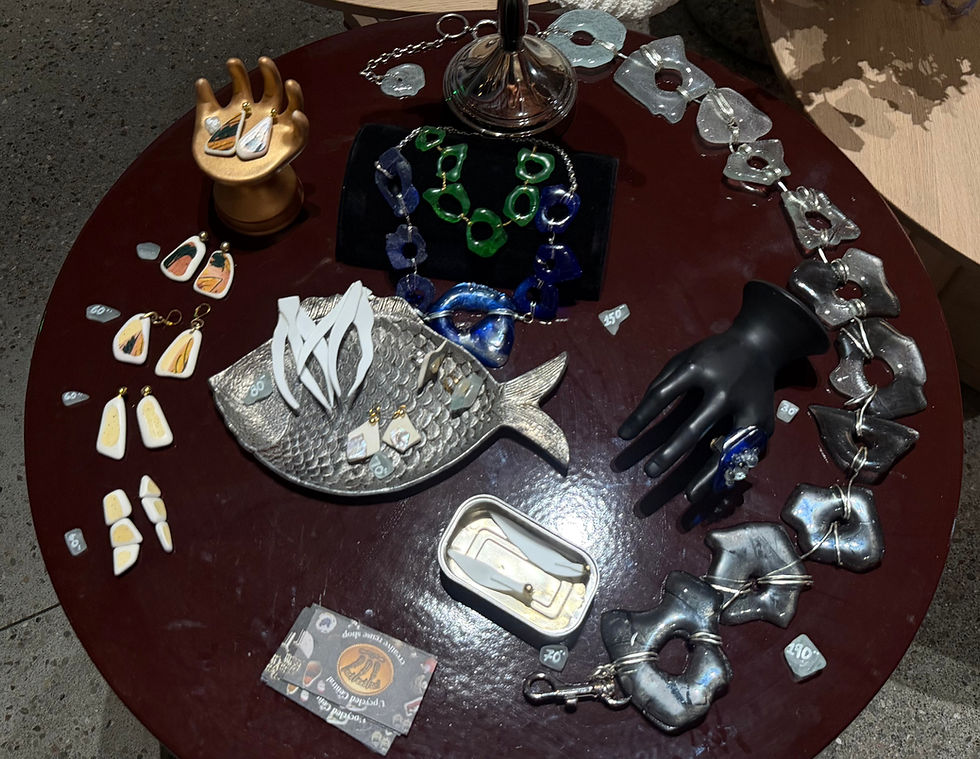
Jewelry and accessories by Upcycled Central, captured on iPhone by Tiffany Hua (me).
Bridget and I perused, got ourselves some yummy treats, and were ready for the show to begin. There were a couple of friends I knew in the show, either as a designer or model, so I was especially looking forward to seeing the looks in action. More and more people trickled in, buzzing with excitement. The show opened with Textiz Weave & Emordes Studio, a beautiful collaboration of pre-colonial Ilocano weaving and avant garde silhouettes. Izabelle of Textiz Weave weaved using algae-yarn biomaterial, and JH Sedrome of Emordes Studio sewed the looks together with pleated detailing.
What I loved about the curation of designers was that it was a distinct range of styles and interpretations of the show’s theme, before it was mine. Some designers stuck with preservation of indigenous techniques like Textiz Weave, and others modernized textiles like Bodies As Clothing, which uses therapeutic plant and plastic free dye for their garments while still working with Balinese artisans.
Some of my favorite looks that stuck out was Calixta Lehman’s 2nd collection, “The Nanang”. Her looks reminded me of Disney Princesses, from a corset asymmetrical ballgown to a two piece look, featuring beaded jewelry, belt, and headpiece.
Designs by CL Design, photographed by Camy Totah.
Another one of my favorites was this metallic teal two piece set by Lily Forbes (this look reminded me of Sandy Liang’s S/S 2025). Forbes’ collection was full of color and sheer textiles, making it very dreamy. All of her textiles are “ethically sourced natural textiles and guided by socially and environmentally thoughtful production.”
Left to Right: Designs by Lily Forbes, photographed by Camy Totah and Roberto Benitez.
I wish I could go through every single one of the 15+ designers on the bill, but please, take the time to look through The Living Archive’s Instagram for the rundown of all designers and their Before It Was Mine looks!
On Day 2, there were two panel discussions facilitated by KQED. The first panel was with the designers, discussing their craft and the intersection of cultural preservation, sustainability, conscious consumption, and fashion. It was incredibly insightful listening to each of them talk about their creative process and commitment to ethical production. On the second panel, Kara was featured alongside other key gifting partners from the event such as Roboro, a textile and circulatory agency helping fashion build practical systems for circular fashion. This panel explored deeper into ethical consumption in a material-driven world and the future of fashion sustainability.
The event was absolutely inspiring. I left both days feeling grateful to have been in the presence of so many passionate individuals who are clearly so dedicated to their craft. I saw so many familiar faces, made new friends, and experienced how vibrant the fashion community truly is in San Francisco.
After the event, I sat down with founder, Kara, to talk about the behind-the-scenes process of planning and self-funding Before It Was Mine, preserving and honoring tradition through clothing, and redefining what fashion events can be, with a commitment to community building in San Francisco. Here are some key highlights from our conversation:

Kara Fabella, founder of The Living Archives. Photographed by Camy Totah.
Tiffany: Since this is the second iteration of The Living Archives, how did the vision evolve from the first show, and what felt different bringing this event to life?
Kara: The venue was a massive shift. For our first event, we curated our showroom space from the ground up, whereas this time around, we worked within the physical layout and constraints of the Rivian showroom in San Francisco. We leaned into a heavy designer, archive table, and activation focus, introducing our conceptual theme, Before It Was Mine.
“Perhaps the biggest milestone, though, was that this was our first fully self-funded iteration. It’s an event series that we completely own and operate ourselves, without relying on an existing institution or external backing.”
TH: The theme, "Before It Was Mine," explores the history of fabric, technique, and silhouette. What does that theme mean to you on a personal level?
KF: For me, it’s deeply tied to heritage and documentation. I grew up with grandparents who didn't talk openly about what happened in their past due to trauma and wars in the Philippines. Having lost my maternal grandparents in recent years, I often reflect on the regret of not being able to extract more of their stories.
My way of connecting back to those histories and ancestral roots is through fashion and textiles. Featuring Filipino-American designers like Isabel, Niana, and Calixta—who actively weave native fabrics, traditional butterfly sleeves, and self-taught techniques into their work—is both an educational experience for me and a tribute to that lineage.
TH: What gap do you feel The Living Archive fills for the local emerging fashion scene in the Bay Area?
KF: I want warmth and thoughtful interactions, where the audience can engage with the runway, step into the showroom, and immediately speak with the designers after the show.
Beyond that, it’s about providing context behind the garments. In mainstream fashion, 'sustainability' gets reduced to green-washing jargon while ignoring human stories, supply chain justice, and cultural heritage. I want to bridge the context behind why designers do what they do and foster an environment where everyone feels part of the conversation.
TH: What do you hope audiences take away when they walk out the doors of a Living Archive show?
KF: I hope they leave with good energy and feeling inspired. I want them to feel a sense of curiosity, not just toward the aesthetics of the fashion show, but toward the showroom, the archive tables, and the panel discussions.
If attending this event plants a seed for someone to become curious about how a garment is made, or inspires them to learn how to mend, sew, or ask where their clothes came from, then we’ve done our job.



Comments